


Blog post
'It's a privilege': Carmen Figueroa reflects on donating a kidney to her brother with the support of AKF's Living Donor Assistance Program
Carmen Figueroa shares her living donation story and how AKF supported her
This story is part of a series highlighting how AKF's Living Donor Assistance Program is helping ease the financial burden associated for living kidney donors as they give the gift of life.
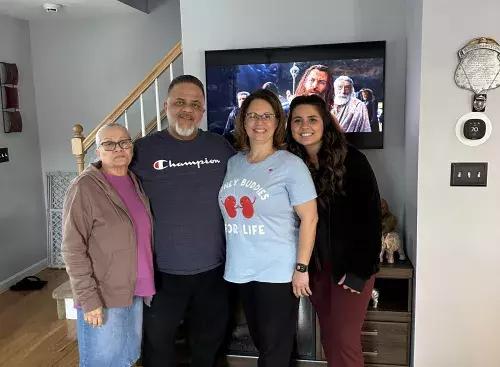
When Carmen Figueroa found out her brother was going to need a kidney transplant, it came as a complete surprise to her and her family. He had focal segmental glomerulosclerosis, a serious and rare kidney disease, but had been taking medicines for years to help manage it.
"He kept it from us," Carmen said. "He was going away on vacation and told my mom [he needed a transplant]. He said, 'I just want to let you know I'm on the transplant list,' like, out of nowhere."
After her mother told her what was going on, Carmen reached out to her brother to ask why he hadn't filled the family in about the state of his health. "He said, 'I didn't want you guys to worry. I knew that eventually I would have to have a transplant, and it's now time,'" she said.
Unfortunately, being on the waitlist doesn't guarantee that someone will get a kidney right away. In Massachusetts alone — where Carmen's brother lives — more than 3,000 people are waiting for a kidney. That's where living kidney donation comes in as a potential option for people like Carmen's brother who are in kidney failure.
At the time Carmen found out her brother was on the transplant waitlist, her niece — one of her brother's children — was already going through the process of getting tested to see if she could donate a kidney to him. Carmen's brother broached the idea of his sister getting tested as well, although he was hesitant to do so. "He told me, 'I don't want to pressure you or ask you,' but I'm asking you," Carmen said with a chuckle.
Without hesitation, she said yes, and insisted that she be considered first to be the potential donor for her brother. "I spoke to the [transplant] coordinator, and I said, 'I know the other person that is going through this process. I know the risks. Can you please put me first?", she said. The coordinator granted Carmen's request, and testing revealed that she was a perfect match.
In November 2024, Carmen flew from her home in California to Massachusetts — where her brother lives — to tell him about the good news in person, and to get an evaluation. Her brother was overwhelmed by his sister's generosity. "He said, 'I can't believe you're here. I can't believe you're doing this. Why are you doing this?'" Carmen recalled with tears in her eyes.
For her, the 'why' was simple. "He deserves it," Carmen said. "He's an awesome dad. He served our country, then he became a firefighter and then he became a cop. I wanted him to have a second chance to see his children get married and have children." In addition, as someone who works in the medical field, Carmen was not unfamiliar with or intimidated by transplants. "I'm a respiratory therapist," she said. "I assist in bronchoscopies, and we're always [working with] transplant patients."
In January 2025, Carmen once again traveled to Massachusetts, and on Jan. 15 — the day before her birthday — Carmen gave her brother one of her kidneys. Recovery for both went smoothly, with Carmen's brother getting up and walking around the hospital the day after receiving his new kidney. "He was ready to go," Carmen said. "He stood up straight and all of his pain was gone." Six months later, her brother is still doing great. "His numbers are amazing, and he continues to be in the green," she said.
As for Carmen, she said it didn't take long for her to get back to feeling normal. "At the beginning, it was just an ache on [my] right side, but other than that, honestly, it was easy. To me, nobody should be afraid [of donating a kidney]. I've had other surgeries and I've had more pain with that than what I had with donating an organ."
Carmen's recovery was also aided by the financial support she received from the American Kidney Fund (AKF)'s Living Donor Assistance Program, something her transplant coordinator told her about. The program aims to increase access to living kidney donations by reimbursing out-of-pocket costs for living kidney donors. Although Carmen was able to take time off work to donate without fear of losing her job, she faced costs that were not insignificant, including two sets of cross-country flights.
"[The Living Donor Assistance Program] gave me $2,500, which I thought was like — wow," Carmen said. "I did not expect that. I expected nothing, but when [the program] helped me, that was very humbling." She said she was able to use that funding to cover the price of her flights.
Carmen encourages anyone who is considering becoming a living donor to not overthink it. "Know that yes, it's a change in your life because you're going to give a part of you," she said. "But that change is beautiful because you know that you help someone get off dialysis and have a better life. It's a privilege, and I hope and pray that [by sharing my story], I can help somebody make that choice [to be a living donor] and be comfortable with it."
To learn more about becoming a living donor, visit AKF's website.
Get more information about AKF's Living Donor Assistance Program here.

Related articles

Blog post
A closer look at new treatments, clinical trials and technology in kidney care

Press release
AKF has activated its Disaster Relief Program to assist dialysis and post-transplant patients affected by the wildfires in Washington state.

Press release
New resources include interactive online course providing step-by-step support before and after a kidney transplant

Press release
Symposium will highlight AKF's work to advance kidney health equity through its Kidney Health for All® initiative