


Blog post
A new role for Jesse Eisenberg: living kidney donor!
The Oscar-nominated actor and screenwriter recently became an altruistic kidney donor
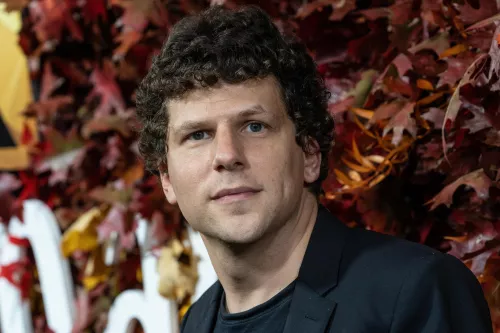
When Jesse Eisenberg appeared on the TODAY show in late October the interview took a surprising turn when he announced he would be taking on a new role: a living kidney donor!
"I'm actually donating my kidney in six weeks," the Oscar-nominated actor told the hosts. "I really am."
Jesse Eisenberg, famous for his roles in The Social Network and the Now You See Me franchise and for his Oscar-nominated writing of A Real Pain last year, has been an outspoken proponent of blood donation, even participating in a blood drive on the TODAY show the year before. He explained that he was "bitten by the blood donation bug," and decided he wanted to donate a kidney.
In recognition of his lifesaving gift, Eisenberg was recently included on the TIME100 Health 2026 list. Each year, TIME magazine creates this list to honor the leaders who are "are advancing care, shaping policy, and driving innovations that transform lives."
"It was immediately clear to me that I should do it," Eisenberg told TIME magazine in his profile for the TIME100 Health 2026 list. "It just seemed like an obvious thing to do."
There are two types of kidney donors: deceased and living donors. A deceased donor is someone who has given permission for their kidney to be donated after they have died. But kidneys are one of the only organs that someone can donate to another person while they are alive — like Eisenberg did. This is because most people have two kidneys, but can live a completely healthy, normal life with only one kidney.
"It's essentially risk-free and so needed," said Eisenberg in another interview with TODAY.com. "I think people will realize that it's a no-brainer, if you have the time and the inclination."
For people living with kidney failure — the final stage of kidney disease when your kidneys no longer work — the only treatment options are dialysis or a kidney transplant. While neither is a cure for kidney disease, a kidney transplant is often the best treatment option for kidney failure.
Currently there are more than 96,000 on the kidney transplant waitlist in the United States. Unfortunately, because there is a shortage of available organs, people on average wait three to five years for a kidney transplant from a deceased donor. A living kidney donor can dramatically shorten this wait time.
In addition to shortening someone's time waiting for a lifesaving treatment, kidneys from living donors generally present fewer complications for the recipient and last longer than kidneys from deceased donors. On average, living kidney donor transplants last 15 to 20 years. Deceased donor transplants last 10 to 15 years on average.
About 23% of the kidney transplants performed in the U.S. last year were the result of living kidney donations.
What makes Eisenberg's decision even more admirable is that he chose to be an altruistic donor — making what is also known as a nondirected donation. While most people who choose to donate a kidney are donating to someone they are related to or know in some way — a directed donation — an altruistic donor donates their kidney to a stranger. Last year in the U.S. less than 600 of the more than 6,000 living kidney donor transplants were the result of anonymous donations, according to the Organ Procurement and Transplantation Network.
Eisenberg told TIME that his transplant, which took place in December, went smoothly — he had no complications and, five weeks post-op, feels close to how he felt before the surgery.
Reportedly, he opted to do his donation through the National Kidney Registry's transplant voucher program, meaning he will receive a voucher that someone of his choosing can then use to receive a kidney in the future. Eisenberg told TODAY that he put all the members of his family on his voucher list. "So, it's risk-free for my family, as well."

On Feb. 11, Eisenberg was one of three honorees to speak at the TIME100 Health Impact Dinner. In his remarks, Eisenberg spoke about how he wants to shrink the organ transplant waitlist. "I never heard from anyone or read an interview with anybody who said they wrestled with the decision. … It was always: 'I heard about it and signed up,'" he said. "Which makes me wonder if the problem isn't convincing people to do this, but simply finding the people who already would."
Eisenberg added, "That's the reason I wanted to speak tonight — and to briefly co-opt this gathering of otherwise brilliant minds — because I imagine there is no more qualified group of people who could figure out how to reach these particular people, how to shrink that horrible number of 90,000 people to close to zero."
AKF is dedicated to fighting kidney disease on all fronts and envisions a future free from kidney disease. As part of this effort, we work to encourage more people to consider organ donation and to remove barriers to kidney transplant for donors and recipients.
As part of our mission-driven efforts, AKF provides long-term financial assistance that makes transplants and post-transplant care possible for low-income dialysis patients. In 2025, AKF grants helped 1,673 people nationwide receive kidney transplants — roughly 6% of all kidney transplants performed in the United States last year. AKF also established the Living Donor Assistance Program to increase access to living kidney donations by reimbursing out-of-pocket costs for living kidney donors who donate a kidney in certain regions.
We applaud Eisenberg for his selfless decision to donate a kidney and give someone the gift of life.
If you would like to learn more about kidney transplants or about becoming a living kidney donor, here are some AKF resources for you to explore:
- Kidney donation and transplant
- Your guide to kidney transplant
- Types of living kidney transplants
- Learn about the waitlist
- Evaluation for transplant
- Organ and tissue donation myths debunked
- Examining the altruism of kidney donation
We also encourage you to read stories from other living donors:
- 'Better than meeting red pandas,' says living kidney donor about donating her kidney to a stranger
- 'Watching someone's life turn for the better is honestly the most beautiful thing you could ever experience': Maura Smith's unusual kidney donation swap
- 'Saving someone's life is really priceless,' says 30-year-old living donor

Related articles

Blog post
AKF's Living Donor Assistance Program helped make it possible
Blog post
Kafayat Onanuga discusses what led her to donate a kidney to her mother, and how AKF made the donation process easier.
Blog post
Maura Smith shares the story of how she donated a kidney to her brother-in-law
Blog post
Carmen Figueroa shares her living donation story and how AKF supported her