


Blog post
'Watching someone's life turn for the better is honestly the most beautiful thing you could ever experience': Maura Smith's unusual kidney donation swap
Maura Smith shares the story of how she donated a kidney to her brother-in-law
This story is part of a series highlighting how AKF's Living Donor Assistance Program is helping ease the financial burden associated for living kidney donors as they give the gift of life.
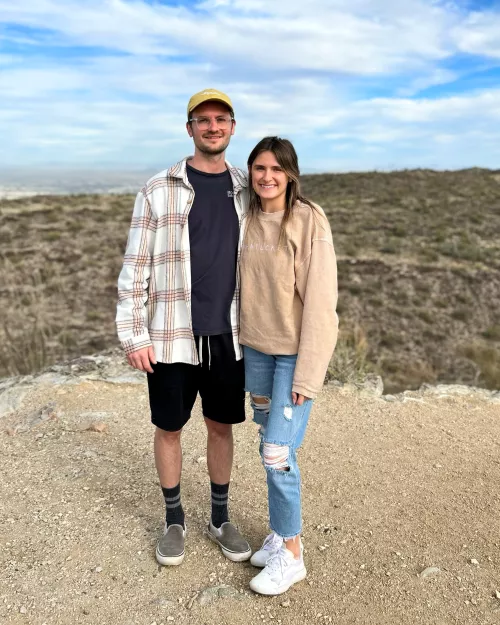
Maura Smith and her fiancé Tom Tusinac have been together for more than 10 years and are set to officially become family on Sept. 12. But Maura doesn't have to make things official to consider Tom's family to be her family too. So, when Tom's older brother Dylan needed a new kidney, she didn't hesitate to offer him hers.
"I'm an organ donor if I die, so, for me, I'd rather see it while I'm alive than [donate] when I've passed and can't witness the progress and the benefits it gives somebody," Maura explained.
Dylan has a rare type of kidney disease called Alport syndrome. Alport syndrome is a genetic disease caused by problems with three genes that control the way certain parts of your body are shaped. When there are problems with these genes, parts of your kidneys, ears and eyes do not grow correctly. Alport syndrome can cause hearing loss and eye problems, but it always causes kidney disease. Chronic kidney disease can eventually lead to kidney failure (or end-stage renal disease), which requires dialysis treatments or a kidney transplant for the person to survive.
This kidney transplant would be Dylan's second, having received his first when he was nine years old. It was during that transplant process that Dylan learned he has Alport syndrome. His family members all got tested to see if they could donate to him. While Tom learned he does not have the disease, their youngest brother, Brett, did. Neither was able to donate, but fortunately, their father could.
Dylan was able to keep his first donated kidney for 24 years. However, they all knew he would eventually need another one. In 2023, that time was fast approaching.
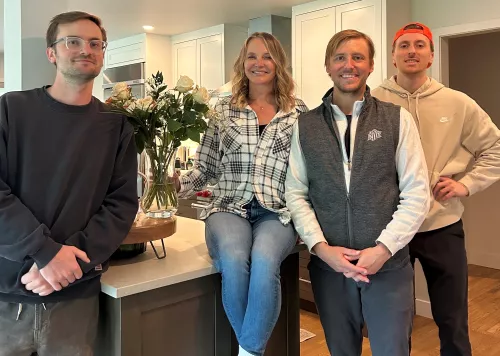
That's when Maura stepped in. Despite her future in-laws' assurances that she did not have to do this, Maura began the testing process to see if she could donate to Dylan.
"We weren't a direct match due to antibodies," said Maura. Fortunately, the two could do a paired donation instead. With kidney paired donation (also called paired exchange), two donor and recipient pairs swap donors to get better kidney matches. Dylan was not in immediate need of his transplant, so they had some time to find another donor to do the swap.
Little did they know they would be doing a different kind of donor swap.
"While we were waiting for Dylan to come up to that point of needing [his transplant], his younger brother [Brett] started to have drastic kidney failure," explained Maura. Suddenly, Brett needed a kidney sooner than Dylan. That's when Maura offered to be a donor a second time. "I was already in the system [and] I was already cleared health wise, why not just see if I'm a match."
The two turned out to be a match and on Jan. 8, 2025, Maura did a direct donation to Brett.
While Maura had minimal concerns about the surgery and said the day of surgery was "so mellow" for her, Brett was worried, mostly about his future sister-in-law.
"It was the sweetest thing in the world," Maura said. "He kept asking, 'Is she comfortable? Is she ready? What do they have her doing? Is she all right?' And you could just see the worry on his face that things would go wrong or that something wouldn't work out. But overall, everything was fantastic."
After a smooth surgery, Maura was released from the hospital about two days later. She said she's had very little difficulty in her recovery and would barely know she only has one kidney. "Even now, I forget that I did it until I see the scars."
When the doctors recommended Maura take eight weeks off work to recover from surgery, she was more concerned about the potential for financial problems than physical ones.
"I've got some sick time saved up and I can take medical leave," Maura remembered thinking. But she wondered if there was any way to shorten that. Even though her job was understanding, she wondered if taking that much time off was something she could afford to do. "Because not having that pay for two weeks, four weeks, especially in the state of New Jersey, things are so expensive [it would be hard]."
Fortunately, she learned about the American Kidney Fund's (AKF) Living Donor Assistance Program from her social worker.
"New York Presbyterian is so fantastic and amazing with their living donor program," Maura said. "They supply you with your medical team, of course, and you have your doctor, your primary care or your care physician that's the lead. But then they also supply you with a financial advisor, a social worker and an advocate. So, you get this whole team of people dedicated to you, which is something I didn't expect."
The Living Donor Assistance Program works to increase access to living kidney donations by reimbursing out-of-pocket costs for living kidney donors. Maura said receiving the grant was "highly beneficial" and had a huge impact on her living donor experience.
"It provided my fiancé, Tom, the ability to take a few days off from work and stay nearby and provide support for his brother and myself while we were in the hospital," she said. She added that it allowed Tom to stay in a hotel instead of commuting back and forth from New Jersey to New York to see them during the limited visiting hours. "Being given the grant money really [provided] the flexibility of having somebody there as moral support more than anything."
The grant also helped ease the financial burden of that commute for Maura herself.
"People don't realize the tolls add up. Crossing the George Washington is not a cheap feat," said Maura. "So, all of those visits in to have an X-ray, the CAT scan, any blood work, meeting with my surgeon specifically, and meeting with my medical team even in those first months, when I was originally doing it, those little fees start to add up and you don't realize."
Brett stayed in the hospital a few more days than Maura and had some challenges finding the right combination and dose of medicines after transplant. However, he is now doing very well post-transplant.
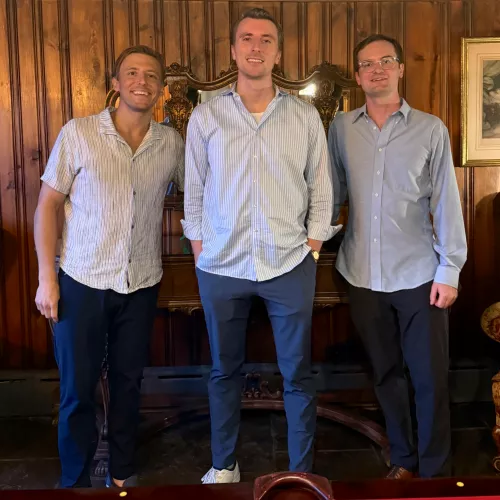
"Seeing him now, six months later, it's like a whole different person," said Maura. "He's got energy again. He's got that glow back in his face."
As for Dylan, he's found another donor, and his surgery is confirmed for October 2025.
In the meantime, the oldest Tusinac brother is there to help the youngest navigate post-transplant life. Maura said Dylan "constantly stresses to [Brett] to take your meds on time. Don't forget. They're a very supportive family of each other."
Maura strongly encouraged anyone thinking about becoming a living donor to do it. "You won't regret it," she said. "Watching someone's life turn for the better is honestly the most beautiful thing you could ever experience."
Learn more about becoming a living donor on AKF's website, and find more information about the Living Donor Assistance Program here.

Related articles

Blog post
A closer look at new treatments, clinical trials and technology in kidney care

Press release
AKF has activated its Disaster Relief Program to assist dialysis and post-transplant patients affected by the wildfires in Washington state.

Press release
New resources include interactive online course providing step-by-step support before and after a kidney transplant

Press release
Symposium will highlight AKF's work to advance kidney health equity through its Kidney Health for All® initiative