Blog post
When searching for a kidney goes from 'somewhere down the road' to 'right now'
AKF 2022 Hero of Hope Ellie Hanley shares her experience with the search for a kidney donor
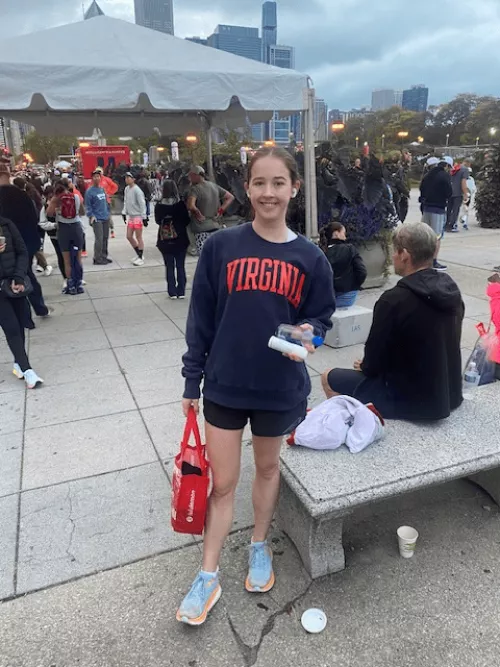
Many people have compared the process of being on dialysis and waiting for a kidney transplant to running a grueling marathon — and 21-year-old Ellie Hanley has experienced both. A marathon runner and college student, Ellie recently became one of the 94,000 people in the United States waiting for a kidney transplant.
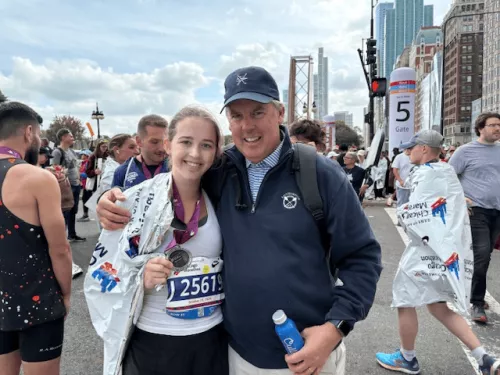
We caught up with Ellie, who in 2022 was named AKF's Hero of Hope, the highest award given to a kidney patient in the United States. The youngest person to receive this award, she was honored at age 18 because, while living with the rare kidney disease focal segmental glomerulosclerosis (FSGS) she overcame her health challenges to run the San Francisco Marathon and raised an incredible $27,000 to support AKF's programs through KidneyNation. Since 2022, she has run two more marathons: the 2023 Hamptons Marathon and the 2024 Chicago Marathon. Ellie is in her senior year at the University of Virginia, working toward a bachelor's degree with dual concentration in finance and management.
Ellie was diagnosed with FSGS at age 11 and was able to keep it under control with medication for 10 years. Ellie stayed rigorously committed to her medication regime and the rest of her nephrologist's health care plan throughout her first three years of college, but despite her best efforts, her health took a downturn in late 2024.

"I was traveling with my family over Christmas when I noticed how swollen my ankles were getting and that was an indication that something was wrong, but at the time I felt perfectly healthy," said Ellie. After months of working with her nephrologist to stabilize her kidney function, eventually dialysis became necessary, and she began treatment over spring break 2025.
"I always knew there was a possibility that somewhere down the road I would have to do dialysis or get a kidney transplant," said Ellie. "Kidney failure never seemed like a reality and maybe would be decades down the road, and I never even really knew what I meant when I said that. I didn't expect it to be something that would suddenly be in the near future."

Being on dialysis hasn't slowed her down. This past summer, she completed an intensive internship on Wall Street, while doing dialysis at night — and did so well, she was offered a full-time job once she graduates from University of Virginia in spring 2026.
"My typical schedule [this summer was] waking up bright and early to work out in the morning before work, going to my internship all day, and then going straight to dialysis in the evening. Obviously this is a very demanding schedule and dialysis can be a very draining process, but I'm grateful that I'm able to do all things that I want to do."
Ellie is on the deceased donor transplant list. But because the available supply of donor organs is so limited, people on average wait three to five years for a kidney transplant from a deceased donor. Ellie, like so many others with kidney failure, is searching for a living donor to shorten the wait time. Her immediate family members are not a match to donate, and so her family is working with the University of Virginia direct donor/paired donation program.
There are several benefits of living donation over deceased donation. A kidney from a living donor usually lasts longer. Many studies have shown that a living donor kidney can last between 15 to 20 years compared to 10 to 15 years for a deceased donor kidney. In 2024, about 1 in 4 kidney transplants came from living donors.
Finding a living donor is challenging. Many who seek a living kidney donor try a combination of approaches to assist in their search — asking family and friends to spread the word, sharing their story online, reaching out to local media. Others have come up with creative ways to find a donor, like colorful yard signs, renting a billboard truck or creating a Tik Tok post. And some people have found donors in surprising places, like from a long-time friend, a stranger at church or the salesperson at a furniture store.
Ellie is now hoping she can find that unexpected living donor, with her family helping her with outreach. "We have posted on Instagram, sent out emails to many families and friends, and my high school community has been helpful in spreading the word to find a living donor," she said. She said that it can be hard to make the ask, but she has been surprised by people's reactions. "It is so amazing and shocking that a simple email or Instagram post can have, especially with words of support and love… You learn through the outreach how much people want to help and how it can change the lives of both me and the donor so much."
If you are, like Ellie, looking for a living donor, you can find more tips for how to make the ask, including an email template and tips for sharing your story, on AKF's website.
If you are interested in becoming a living organ donor, you can find out more about the process on AKF's website.

Related articles

Press release
Program aims to improve diagnosis, support disease management and help people living with focal segmental glomerulosclerosis (FSGS) better understand available treatment options
Press release
Additional seasons will focus on mental health, innovations in kidney disease
Blog post
AKF Ambassadors and RKDAN members who are living with FSGS share their stories and what a treatment would mean to them.