


The Kidney Collective: I Wish I Knew That Diabetes Could Cause Kidney Disease
A conversation with Robert "Buzz" Buchanan, as part of The Kidney Collective's introductory podcast series.
Oct. 15, 2025 | The Kidney Collective
In this episode of The Kidney Collective, Tamara and Mike talk with Robert "Buzz" Buchanan about his experience living with type 2 diabetes and stage 3 chronic kidney disease (CKD) — and their shared love of Jimmy Buffett. He was diagnosed with diabetes in 1998 and has managed his CKD for over 10 years, keeping it from progressing to kidney failure. In the face of the unique physical and mental challenges of a chronic disease, Buzz advises others to "not panic," and shares how he has managed his conditions through lifestyle changes, medicines and regularly monitoring his health with routine testing. The three also discuss the connection between heart, kidney and metabolic health and share the benefits of participating in clinical trials. Buzz emphasizes how important it is for people to have access to clinical trials and to the latest medicines and treatments.
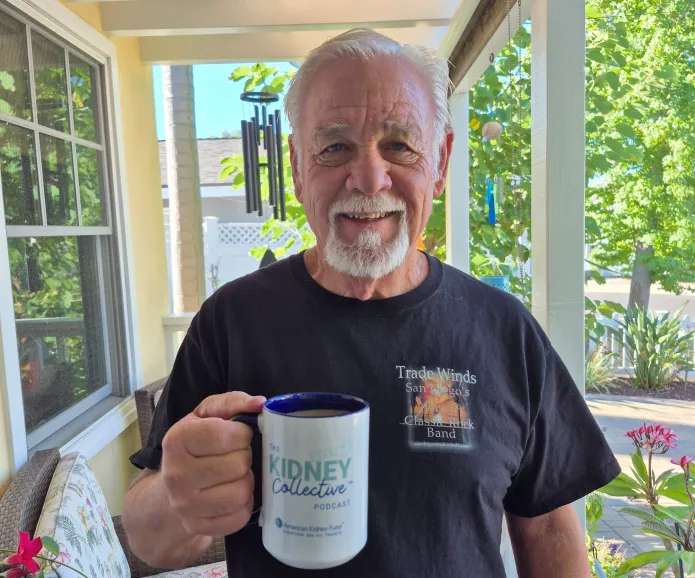
About Our Guest
Buzz Buchanan
Robert "Buzz" Buchanan is a fifth-generation resident of San Diego, California where he has lived his whole life. He was an orthopedic technician for 30 years and has been retired since 2015.
Show Notes
- Buzz was diagnosed with type 2 diabetes in 1998 and stage three chronic kidney disease later on.
- He managed to keep his kidney disease from progressing for over 10 years. Lifestyle changes, including weight loss and medication, were crucial for Buzz's health.
- Buzz emphasizes the importance of regular check-ups and monitoring for kidney health.
- He highlights the connection between diabetes and kidney disease, stressing the need for awareness.
- Buzz encourages others not to panic after a CKD diagnosis and to maintain a balanced lifestyle. He advocates for the importance of good medical care and support systems.
- Buzz shares his experience with clinical trials and their significance in advancing treatment.
- He believes that education about one's condition is vital for effective management.
- Buzz's story serves as a reminder that with proper care, kidney disease progression can be slowed or stopped.
- More resources:
Chapters
- 00:00: Introduction to The Kidney Collective
- 01:11: Bonding over Buzz's Jimmy Buffett Cover Band
- 02:00: Buzz's Type 2 Diabetes Diagnosis
- 04:33: Managing Diabetes and Lifestyle Changes
- 06:37: The Connection Between Diabetes and Kidney Disease
- 10:50: Financial Barriers to Diabetes Medication
- 11:53: The Importance of Monitoring and Screening
- 14:49: Advice for Newly Diagnosed CKD Patients and Diabetes Patients
- 21:48: Getting Answers, Medical Support and Staying Positive
- 27:27: Navigating Clinical Trials and Their Benefits
- 30:10: Recap of Buzz's Conversation
Transcript
Buzz Buchanan: Hi, this is Buzz Buchanan and I wish I knew that diabetes could cause kidney disease.
Tamara Ruggiero: Hello, I'm Tamara Ruggiero.
Mike Spigler: And I'm Mike Spigler.
Tamara Ruggiero: And welcome to The Kidney Collective, a podcast series that gives voice to what it's really like to live with kidney disease. In each episode of this limited series, we'll talk to a member of the kidney community about their experience, including what they wish they had known before their journey began.
Mike Spigler: Join us for a personal look at what life is like in The Kidney Collective and come away with information and inspiration to help you know how to take charge of your kidney health.
Mike Spigler: Today we are joined by Robert "Buzz" Buchanan. Buzz is a fifth generation resident of San Diego, California, where he has lived his whole life. He was an orthopedic technologist for 30 years and has been retired since 2015. Buzz was diagnosed with type two diabetes in 1998 and was later diagnosed with stage three chronic kidney disease. He has managed his chronic kidney disease for over 10 years, keeping it from progressing to kidney failure.
So Buzz, I want to jump on the question because I got some information about you before we did this meeting with you. And it said that you are a percussionist in a band, but not only that, you were formerly in a Jimmy Buffett cover band. And as a Parrothead myself, I just wanted to ask you a very important question, is what is your favorite Jimmy Buffett song?
Buzz Buchanan: I really don't have a favorite. I like more of the mellow, just, him and fingers playing that kind of style more than the more party type music myself. Even though when you play in a band, you you may play more of the top 40 songs or...
Mike Spigler: Right, right.
Tamara Ruggiero: Thanks for talking to us, Buzz. So, yeah, so our first question for you was, I understand that you were diagnosed with type two diabetes in 1998. Can you tell us how you received that diagnosis? Did you have any symptoms that made you seek out a doctor or was it during routine, like a routine physical, or how'd you find out?
Buzz Buchanan: So actually I was at work and one of the nurses, I was having a little problem concentrating and doing things. And I told her I wasn't feeling well and she says, well, let's test your blood. And so she got out her meter and tested me and I was, I think I was about 280 for my blood sugar.
And I was kind of having tunnel vision. And I'd had these symptoms before, but I never thought about getting tested. I wasn't being tested for A1C at the time. And so anyway, that was my first diagnosis. Looking back, I had type 2 diabetes way longer before my actual diagnosis.
So because of the symptoms, when you're having symptoms of diabetes, a lot of times you have to go to the restroom more often. Well, I thought, I need to be hydrated more. So I made the mistake of now drinking Gatorade, that would hydrate me better. And all it did was increase my blood sugar and made it worse. So that was a rude awakening in a sense. And I couldn't lose weight.
So that was another thing that I was gaining weight instead of losing weight. So, of course I wasn't really thinking about it as much because I was burning the candle at both ends. I was playing in the band and I was working full time. So that added to that also.
Tamara Ruggiero: Yeah. Yeah. How long did you, how long do you think you might've had type 2 diabetes before you were diagnosed?
Buzz Buchanan: I'd say at least five years before then. So I was, you know, obviously what they call pre-diabetic probably and this seems like the stress brought on a little bit of it. And during that time, I also had a large kidney stone that also that I think might have contributed to my kidney disease in the long run.
Tamara Ruggiero: Oh, so you were dealing with a lot. And I think we're going to ask you in a minute about the kidney disease, but just in terms of finding out you had type two, I imagine you had to implement quite a few lifestyle changes after your diagnosis. Can you walk us through sort of how you handled the diagnosis and then the changes that you made?
Buzz Buchanan: Well, I ended up diagnosis of just part of my life. It wasn't like I had to start, you know, using insulin and doing injections. I was using just medication at first and, and it was controlled quite easily by medication. In fact, right at the beginning, the medications worked too well. I was starting to get too low of the blood sugar and I had to cut back on my medications. But I tried to cut out a lot of food that I used to eat as far as fast food as much.
I was never really a big drinker. And, but I made sure that I cut most of that out. Maybe I would have like one or two beers every two weeks or whatever, but that'd be it. The big thing that happened is I got to be enrolled in a weight loss clinical trial. And I was taking a, they were giving me this weight loss drug and were monitoring me. And I lost, I think about 25 pounds on that program. And that seemed to help quite a bit. And then since my diagnosis, I've lost a total of approximately 50 pounds.
Mike Spigler: Wow. Congratulations, that's great.
Buzz Buchanan: So, a lot of it's from trial medication and then the second go around it seems like I just kept on keeping my weight down, not eating too much. It wasn't like I became a vegetarian or anything. I just kind of watched my portions.
Mike Spigler: When you were diagnosed Buzz, did anyone say anything to you that, you know, diabetes has a relationship to kidney disease? Did you know that going into it at all?
Buzz Buchanan: I did not really know that. The doctor, he'd have me on like a, I'm not hypertensive, but he'd have me on a blood pressure medicine. And I'd say, well, why do I, I know I'm not hypertensive. Why do I have to have this blood pressure medication? And he says, we're trying to protect your kidneys. So he was, and because the long-term, they, explained to me the long-term medication that I would be taking would possibly contribute to kidney disease. And since you had to control the diabetes and the blood sugar, on the other hand, you're possibly harming your kidneys and your liver at the same time. So it's a, you know, it's a balance.
I had a father that had bad coronary disease. And his doctor told him once when he asked, do I really need to take all these pills? And the doctor said, well, not really. But in the meantime, they're keeping you alive.
Mike Spigler: Well yeah, and I think it's something that we're really learning the last few years. There's such a connection between the heart and diabetes and the kidneys, and we call it cardio-kidney metabolic syndrome for those that have not heard of that. And all of those are so connected. So usually when you've got one, you've got to do something to try to manage the other. So that interplay is really, really important.
Buzz Buchanan: Yeah, it could have been that my dad did have some sort of mild diabetic condition, but was never diagnosed. But I was always thinking that because of my family history, I'd have problems with my heart and I have never had any really coronary problems. But now I have the course the type two diabetic disease and the kidney problem.
Tamara Ruggiero: Yeah. How did you take it when you found out that you had kidney disease?
Buzz Buchanan: I just took it as mostly part of my life and the progressing of the diabetic condition. That's one of the reasons why the doctor, my primary care, has weaned me off of Metformin for the most part in taking the newer drugs.
I'm taking Rebelsis and Jardiance. And so we're seeing how that's gonna help. I do have to take a small amount of Metformin still, still 500 milligram, but he's just trying to keep me in the A1C balance of being below seven. So. Right now, my last couple of tests, I was right at seven.
Tamara Ruggiero: I know what it's like. I mean, I have a very close relative who has type one diabetes and is 82 years old and has spent his life dedicated to maintaining that balance, like keeping his blood sugar under control as best he can and doing everything he can to protect his heart and his other organs. And he really credits being vigilant like that, like you are, with his longevity.
Mike Spigler: Yeah, and I just want to call it for those listening, you know, some of the new medicines that Buzz mentioned. So there's two real new classes for people with diabetes to protect them from kidney disease or if they have kidney disease. SGLT2s and GLP1s are kind of the classes. I know that sounds like a lot of numbers and letters, but we've got plenty of information on our website on our Know Your Kidneys page that can point to some of that.
But if you're listening to this and you have diabetes, I think one takeaway here, and Buzz is a great example of that, is there are lots of medicines that can help with this now that not only help manage your diabetes, they also protect your kidneys, they also protect you from heart problems too. So it's really important that you're listening to what Buzz is saying and talking to your doctor.
Buzz Buchanan: Regarding the medications, I'm just lucky I have a very good medical plan and very good coverage that I can take some of these newer drugs that are actually quite expensive if you don't have coverage for them. So the GLP-1 that you're talking about is quite expensive.
Luckily, my copay is reasonably low. But I notice that when the price comes as a notification, I would never be able to afford that and I'm OK as far as financially. They really need to get those prices lower for people that have this problem but don't have the resources. So hopefully, people aren't going to get, because they can't afford the right drugs and then that makes their kidney problems worse because they can't afford the right drugs for their type 2 diabetes. So we'll see how that plays out but it's another situation.
Mike Spigler: For those of you that don't know, there are five stages of kidney disease, one being kind of the early stage, stage five being the later stage. You've been in stage three. For those of you that, for the listeners that might not know about kind of what the tests are, Buzz, you wanna talk about how often you're tested for your kidney disease, what that looks like when you get it done?
Buzz Buchanan: I'm tested for my 8.1c and I'm tested for my GFR once every three months to monitor that. Once a year I go see my actual kidney doctor that was referred for this program and I see her only once a year.
But my primary care I see every three months and do my laboratories. And everything has been stable ever since I started with both of them. So it's been nine and a half years now since I started with Dr. Swice, which is my kidney specialist.
Mike Spigler: Buzz, do you have urine tests done at all as well sometimes?
Buzz Buchanan: Yes, that's included every three months.
Mike Spigler: Yeah. And that's really the one I think for those listening, if you've been told you have kidney disease or you're at risk for kidney disease and you're not getting that urine test, you really need both tests together. All those tests that Buzz was talking about, urine tests for UACR and blood tests for eGFR for kidney disease, but especially if you have diabetes, like Buzz says, A1C is extremely important. I think we call it, it's the report card for your diabetes because it's not like a one point in time, it really shows how well your blood sugar has been controlled over the last few months. So all of those are extremely important.
Buzz Buchanan: Yeah. So I try to test my, use my meter in the morning once a day just to monitor what my blood sugar is when I start the day. I don't like do it before every meal or do anything like that. I just do that once a day monitor. Usually it's fairly well. Sometimes it's surprising how what you did the day before affects it. Even your stress level affects it. So that's why you got to really sometimes mentally, as far as the blood sugar goes, you got to mentally talk your way down from being to get too upset about things that are everyday, daily problems.
Tamara Ruggiero: Yeah, I'm always sort of fascinated when I talk to my family member who has type 1 and he will tell me, you know, his sugar was high yesterday or low yesterday because of something that he did or experienced that I would never think would affect your blood sugar. And it does. And he just, you know, at this point he rolls with it because he understands that it's very intricate and there are a lot of factors that go into play there.
Buzz Buchanan: Yeah, sometimes I don't necessarily roll with it, but if I test my sugar the next day, I'm going, that's the reason why.
Tamara Ruggiero: Yeah, yeah, that's probably a better description. I guess he doesn't really roll with it per se, but he deals with it. And he's like, okay, I'm gonna go forward with it. I wonder if Buzz, so I'm in a lot of CKD Stage 3 Facebook groups. And I have noticed in there, I would say one of the common themes in there is fear. People are diagnosed with CKD Stage 3, and they don't know what it means for them and their future. You've been able to hold your kidney function steady for years. And what advice would you give to people like that who've maybe just been diagnosed with like stage three, say, and are concerned?
Buzz Buchanan: Well, some people will, you know, I guess panic regarding it, but you just, don't necessarily have to have a complete change of lifestyle. My lifestyle hasn't really changed all that much. They say exercise more, you know, make sure they are hydrated more. Things that you are kind of normal things to do, but I don't, like I didn't go out and start, you know, joining a gym and going to the gym every day and exercising. I'm just, light exercise on a daily basis, walking our dog. And so I just take it as being part of my life. My dad, he had his first major heart attack when he was only 42 years old, and he dealt with his heart issues until, and he passed at 79.
And he actually mostly outlived all his good friends and he thought that he was going to be the first one and he ended up being the last one in a sense. So you can't, I don't think you can panic too much about it as part of your aging process. It's not that everyone's going to get kidney disease, not everyone's going to get heart disease. I'm really pleased that it's not like, you know, something else that is like a cancerous situation. So it's something that I can at least, with medicine, it kind of catches up to what your problems are. So.
With my dad, it seemed like every time he had another situation with his heart, there was some medical discovery that had happened and he could take advantage of that. Kind of like with the type two diabetes and the kidney disease, as I've progressed, also medicine has progressed. So, I mean, you can't really necessarily panic about changing your entire lifestyle for a condition that you have to kind of control and monitor, but you have to live with whatever life throws at you.
Tamara Ruggiero: Yeah, I think that's a good philosophy. And I think, you know, one of the main messages we try to get out to people, people who might be listening to this, who have like CKD stage two or three, the progression can be slowed or stopped in many cases. And I think that sometimes there's that fear that I've been diagnosed with CKD, I'm on this inevitable slope to kidney failure. And that just doesn't have to be the case. And so we're working to help people sort of come to terms with that and understand that. I think your experience is a good example of that.
Buzz Buchanan: Yeah, that's why it's good to have good physicians following you too also that understand your problems. I wouldn't necessarily want to take medicine every day, but I know that I have to take it every day just to keep this level and keep it going. So.
I've had lots of friends that now I'm 73 now, so I'm in my later stages. And unfortunately, you have friends that have passed because of certain conditions. Diabetes is, a couple of friends have died from their, they were type one or type two going to type one and then they passed.
And it was because they didn't want to deal with it anymore. And so they didn't really control themselves, whether it be from not doing their insulin correctly, just didn't want to deal with it. So.
Tamara Ruggiero: Yeah. I think it gets overwhelming for people. And I think if you just get in kind of a bad mental place, then it's, it's really tough.
Buzz Buchanan: And if you don't have good coverage, medical coverage, and you're struggling because of they're pricing you out of the system as far as your pharmaceuticals, it's really hard. Then you are in a struggle because it's the, they talk about the people that either buy their medicine or they pay their rent. What do they do? Are they out on the street or are they, you know, then they can't afford the medicine either. And once that happens, that's where the dire straits happen. So.
Tamara Ruggiero: Yeah, I think that's a really important point. I mean, let's think about people who are struggling to control their diabetes. Many of them, like you're saying, facing a lot of uphill financial battles, health coverage battles, don't have the optimal medical care like you've had, and they're just doing their best. And so I think that's a really important point for people to understand.
Buzz Buchanan: But I think people that do have good coverage, they need to use it and to keep themselves monitored and keep themselves on the right path. You can fall off the path and it's okay. But yeah, just get back up on the path and just trust mostly what your physicians tell you. That cost key is to have good physicians in the first place. Sometimes people, even if they can afford it, sometimes they skimp on better coverage and lesser medical coverage just because it's a few dollars less a month.
So they need to have good physicians. We're very lucky here in San Diego. There's like four systems of medical care from the military being here, the VA being here, the University of California being here. And then there's two private organizations based here in San Diego. It's just, and it's because of the competition, and also being in San Diego, it has a little bit of, attracts the physicians that want to come to Southern California to live here. So, you know, it is a good factor, because we've had friends that, have moved and then maybe they don't have as good medical care that we are provided with. So that we've been very lucky.
Mike Spigler: Buzz, one question for you. You have a really strong medical background. I mean, you've lived with your dad with medical challenges. So in just listening to how you're taking charge of your health, I mean, you clearly, it sounds like you can understand the kind of medical lingo that's coming at you and have confidence in talking to your doctors. Being in the medical field, what advice do you have for a patient that just doesn't have that same level of confidence in understanding some of these things? What advice to kind of get the answers that they need?
Buzz Buchanan: Well, I think listening to a program like yours and finding out more about what's going on with your particular condition is important. I mean, being an orthopedic technologist, we used to deal with a lot of people that were diabetic, that had diabetic conditions, diabetic neuropathy, diabetic sores and such that they had quite frankly, they had to have amputations and to take care of their problems orthopedically. So I got a real down-to-earth education regarding these conditions before I was ever partly diagnosed with anything.
So, you know, I saw people go through those struggles, orthopedically with their, conditions. So, it kind of waken me up, but it's not something that you need to, I don't think you need to necessarily fear. It's something that you need just to educate yourself with as much as you can. I don't believe I'm fully educated regarding my problems but I try at least at if I have a question I try to ask the appropriate person, primary care or my or Dr. Swice my kidney doctor, so and you know. It's just something that you just you learn to deal with. But in pain orthopedics, we deal with all these and a lot of times it was just mostly just injuries that people could get over in four to six weeks. But, you know, those injuries would happen, they'd get better and they'd move on. Where, you know, a chronic condition, you don't just move on. But we dealt with chronic conditions also. So it was, there's a little bit of a difference.
This is a chronic condition and it's not like you can take medicine for it and you're gonna be done with that portion of your life. You your broken arm, okay, yeah, it's done unless you break it again.
Tamara Ruggiero: Yeah, that's the thing, it's a chronic condition, but you can live with it and you can live a long healthy life with it.
Buzz Buchanan: Yeah, I plan on living way longer. I keep on kidding all my close friends. I go, you know, I want to be like my dad. I want to be the last one. So that's why I want to take care of myself, because I want to be the last one. I'm enjoying my life as it is. I'm enjoying my retirement. I'm enjoying being able to travel, being physically able to get on airplanes and go to places, whereas I have people I know and even same old classmates and stuff that they can't do that anymore, even at our tender age of 73. And it is a tender age in a sense, hopefully. And so, you know. You can take that magic pill, but you, there's nothing you can do instantly. It's all, it all takes time. It all takes time. didn't lose my weight in two weeks. I lost it over a long period of time with the help of my wife and the help of my physicians. And I think that actually has been the best thing for this disease that I've done. The medicines helped me lose the weight, but it's also losing the weight. I mean, I could have just said, forget about it, just not even tried.
Tamara Ruggireo: Yeah. I think, I mean, think weight loss, especially of the amount that you lost has so many positive health benefits and really just transforms your life in many ways.
Buzz Buchanan : That's why when the university offered me programs in like trials, I took on these trials just for the fact that the worst that was happening is nothing. The only thing it cost me was time. So time to go to these appointments and time to take the tests they needed to take. I was also in a study recently that they were correlating diabetes with fatty liver disease. And where they thought at one time I might have had a fatty liver, this study says no, you don't have a fatty liver. So it's not, that's not the reason why you got type 2 diabetes. And they're trying to figure out if that was the case, would that be an easy way to diagnose or pre-diagnose someone getting type 2 diabetes was if they had what they thought were fatty livers.
Tamara Ruggiero: I just have one last question for you. And it sparked by you talking about being in the clinical trials. And then we'll wrap up. But I'm curious what you would say to somebody who's thinking about being in a clinical trial.
Buzz Buchanan: I think that it's important that people do clinical trials just for the fact that it's going to possibly help them, but also help others down the road. Nothing happens unless someone volunteers to do these trials. And it's important that these trials happen because that's the only way things advance. You can have the laboratories trying to figure it out, but until you actually use a clinical setting to figure out if that really, really works, then there's no reason they can't implement it and things won't get manufactured. A lot of medicines now wouldn't have ever happened without some kind of clinical trial. I mean, the vaccines that we've gotten, the GLP drugs, I mean they were trying all kinds of other drugs before the GLP drugs came along. So.
My wife was actually in a clinical trial for another medication that didn't pan out. I was in that clinical trial. The medication that I was taking never came to market because it didn't, it worked a little bit, but not as well as it could or should work compared to what it might have caused problems down the road. But they have to do those things in order to do it. So I think clinical trials are very important.
Tamara Ruggiero: I would also say for anybody who's listening, Mike, you can give the details on this, but our website has the clinical trial finder. So you can plug in your information and find relevant trials.
Mike Spigler: Yeah, absolutely. We have a partnership with a company called Antidote and they have simplified it because if go to the government website, clinicaltrials.gov, it's a lot of very scientific talk and if you put in diabetes, you're going to get 8,000 different trials coming up. So this really you put in kind of some basic demographics and that limits it down to the ones that you're really qualified for. So we certainly would recommend that too.
Buzz Buchanan: Well, the thing is too about the clinical trials is you might find out something that may have helped you down the road that you didn't even know was going on. So it's kind of like, in a sense, free medicine.
Mike Spigler: Yeah, that's true! Absolutely.
Tamara Ruggiero: Thank you! That was a great conversation. Really appreciate you doing that.
Buzz Buchanan: Oh, you're very welcome.
Tamara Ruggiero: You can now add podcast guest to your list of accomplishments.
Tamara Ruggiero: Well, Mike, I think this was an important conversation with someone who has, I think what we would think of as the most common presentation of chronic kidney disease, right? Type two diabetes that eventually damages the kidneys despite their best efforts to manage their diabetes.
Mike Spigler: Yeah, absolutely. I mean, it causes, you know, almost one in two cases of kidney failure in the United States. So it is a big problem for type two diabetes, but also type one diabetes too. But, you know, his case is so typical of the diabetes epidemic that's in the United States right now, which then leads to the chronic kidney disease epidemic.
Tamara Ruggiero: Yeah. And I think in the case of somebody like Buzz, the CKD generally advances slowly and there are steps you can take to slow its progression, which you talked about a lot in this episode. I think when we hear the word progression, that's a word we talk about a lot with regard to CKD. And, you know, I think that can be a confusing term because progression is usually thought of as positive, but when it comes to CKD, it's not positive.
Mike Spigler: No, exactly. I mean, there's a lot of words I think that get used in healthcare and medical lingo that really misleads people, but you're a hundred percent correct. I mean, it is not progress. You take that progress part of progression is actually the opposite. And even though, like you said, it's very slow, it's something that has to be dealt with and managed. And you know, at least fortunately now, and Buzz is a great example of that, there are a lot of different medications and treatments and lifestyle changes that can be made to, you know, what used to be you would hope to maybe slow it down. But really with some of these new medications that are out there for people with diabetes and kidney disease, not only does it protect like the heart and some of the other things that people are dealing with, but you can, in some case,s actually just stop the progression completely. So it's really important to know that you're at risk for it and get tested because now there are so many things that you can do.
Tamara Ruggiero: Yeah, exactly. And one of my favorite things that he said was, don't panic, right? If you've been diagnosed with CKD, don't panic. I think that's important for people who are diagnosed at any stage. I think it's overwhelming to receive a diagnosis like this, especially if you're not familiar with kidney disease. What are some of the resources you would recommend for people who maybe are recently diagnosed with CKD? These are people who maybe are not close to kidney failure. They're overall doing pretty well with their health, but they just need to know where to go for information and maybe what steps they should take.
Mike Spigler: Yeah. Well, I think there's a couple of different things. mean, certainly, you know, this is a hallmark of our Kidney Action Week that we do every March and you can already see lots of some of the archive sessions we've done on the early diagnosis of chronic kidney disease. And I think you'll hear from patients and doctors who have been through this and dealt with that. You know, I think I our Know Your Kidneys website where you can plug in your numbers and kind of get some questions to ask your doctor based on what stage you're in right now, and there's a lot of organizations and websites outside of AKF too that can help you kind of think about, okay, well, you know, it's one thing if you're diagnosed with stage two or stage three and you're in your eighties versus at 20 years old and really understanding what your risk of it getting worse and getting towards kidney failure is important. One website that I would recommend in a tool is something called the Kidney Failure Risk Equation. So you can actually put in. you know, some of your typical numbers, but some other things about yourself as well. And it'll really give you that kind of prognosis for lack of a better term for, your chances of going into kidney failure, because that's what you want to avoid. Kidney failure is dialysis, transplant, and unfortunately in many cases, some patients' deaths. So, you know, you really want to kind of understand where you are and know what steps you can take. Because like I said earlier, there's so many options for people now.
Tamara Ruggiero: Yeah, and I think we'll definitely want to drop that resource into the show notes along with the other resources you mentioned. And then I guess my final thought was the question of getting to the bottom of what really caused your CKD. Buzz in his case is pretty confident it's from type 2 diabetes. I think that's been confirmed. But, as we know, a lot of people do need to find out what really caused their CKD.
Mike Spigler: Yeah, because it can be, you know, the one thing is you can have diabetes, but you might also have a rare kidney disease. I mean, diabetes is so prevalent that if you've got something else going on there too, you really need to treat both of those things that are causing that. And again, our Know Your Cause site, which I think we've mentioned in some previous episodes as well, is a really good tool for not giving you a diagnosis for what caused it, but at least kind of helping you get the right kinds of questions based on the answers that you give us to talk to your doctor about getting that important step of understanding the causality of your kidney disease.
Tamara Ruggiero: Yeah, exactly. Well, I hope everybody enjoyed the conversation as much as we did, and we're looking forward to seeing everybody else for our next episode of the Kidney Collective.
Tamara Ruggiero: To find out more about the topics we discussed in this episode or to access resources to learn more about kidney disease, go to the episode show notes on your podcast listening platform or go to kidneyfund.org/podcast. And if you haven't already, be sure to subscribe or follow the Kidney Collective wherever you listen to podcasts and leave us a like or review to help us reach more members of the kidney community.
Mike Spigler: You can also follow AKF on all major social media platforms including Facebook, Instagram, TikTok, Blue Sky, LinkedIn, YouTube, Twitter X or whatever comes next. Join us next time. Remember that even in the toughest moments, there's hope ahead and the Kidney Collective and AKF are here for you now.
Related resources
Artículo
Existe una conexión entre la salud del corazón, de los riñones y del metabolismo, y cuando uno de estos sistemas no funciona como es debido puede afectar los otros. Infórmese sobre el síndrome cardiovascular-renal-metabólico (CRM) y el vínculo que hay entre la obesidad, la enferm...
Artículo
La diabetes es la principal causa de la falla renal. Aprenda cómo la diabetes afecta a sus riñones, cómo reconocer los problemas a tiempo antes de que se vuelvan graves y qué puede hacer para proteger la salud de sus riñones.

Conozca los medicamentos que se suelen usar para tratar los problemas médicos relacionados con la enfermedad renal.
Artículo
Conozca las pruebas renales que pueden ayudar a los médicos a detectar la enfermedad renal en sus inicios, tales como los análisis de sangre, los análisis de orina, el ultrasonido renal y la biopsia renal.