




Kidneys Count. Every Day, in Every Way.

This Kidney Month, discover why kidneys count and how you can take action to protect your kidney health – for yourself and for your community.

Get the toolkit

Make a gift
A young girl hugging her mother
Group of older people smiling and laughing

Every pledge counts

Kidney disease is a silent disease. It often does not have any symptoms until it has advanced to kidney failure. But when caught early, you can take action to stop or slow the damage to your kidneys. Early detection saves lives. Take the pledge to protect your kidneys and talk to your doctor about your kidney health today.

Make your kidney health count

Kidney disease is an urgent health crisis, with kidney disease the eighth leading cause of death in the U.S. The kidneys play an essential role in keeping your body in balance. When it comes to your health, your kidneys count.

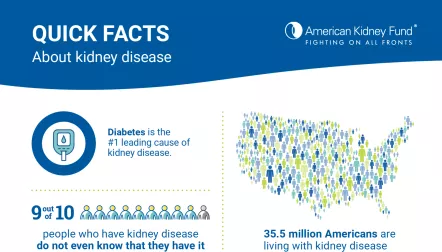
9 out of 10 

people who have kidney disease do not know they have it

1 in 7 

American adults has kidney disease

360 people

in the U.S. begin dialysis for kidney failure every day

1 in 3 

Americans living with diabetes also have kidney disease

Group of young friends hugging and laughing

No one should be counted out.

Kidney health care should be within everyone's reach. However, systemic biases and social barriers put Black and Hispanic/Latino communities at greater risk. These communities are more likely to develop kidney failure, and less likely to receive a transplant. Learn more about our nationwide effort to close gaps in care through education and policy change. 

Conozca las cifras de sus análisis renales

Las cifras de sus análisis renales ayudan a evaluar la probabilidad de tener problemas renales. Los ayudarán a usted y a su equipo de atención médica a determinar qué medidas hay que tomar para evitar o retrasar la progresión de la enfermedad renal crónica (ERC). 

Use nuestra herramienta interactiva Conozca las cifras de sus análisis renales para conocer:

  • Su salud renal actual
  • Su riesgo de tener enfermedad renal en el futuro
  • Cómo retrasar el daño a los riñones si tiene enfermedad renal

Enlace a
Girl wearing sunglasses

Thank you to our Kidney Month sponsors

American Kidney Fund

Knowing the cause can help you and your healthcare team create an informed plan to manage your health.

This tool will not tell you the cause of your kidney disease but will guide you through talking points and questions to ask during your next doctor's visit. By advocating for yourself, you can work together with your healthcare team to try to find the cause of your kidney disease.


By submitting this quiz, you are agreeing to the American Kidney Fund (AKF) privacy policy. Your quiz results will be stored and processed by AKF. If you have any questions, please email info@kidneyfund.org.

1 of 5
Has a doctor told you that you have any of these health conditions? *Required

Choose all that apply:

2 of 5
Have you had any of these tests for kidney health? *Required

Choose all that apply:

3 of 5
Have you had genetic testing to find genes that may be linked to kidney disease? *Required
4 of 5
Do any of your close family members have any of these health conditions? *Required

Close family members include your parents, grandparents, siblings, aunts, and uncles. Choose all that apply:

5 of 5
Are you of Western or Central African ancestry? *Required

You may be of Western or Central African ancestry if you identify as Black, African American, African, Afro-Caribbean, Hispanic or Latino.

Your guide

Start a conversation

Based on your answers, here are some topics and questions you may want to talk about with your doctor at your next visit.

Restart the quiz

Download your conversation guide

Download this guide to share with your doctor during your next visit.

By submitting this form, you are signing up to receive email communications from the American Kidney Fund. You can change your preferences or unsubscribe at any time. Email Info@KidneyFund.org with any questions.

The statements and opinions contained here are strictly those of the American Kidney Fund and do not represent official positions of any governing medical body. This information is not intended to provide medical advice and should not be relied upon as a substitute for professional advice, diagnosis or treatment from a qualified professional. All information presented here should be used in consultation with a doctor of your choice.